
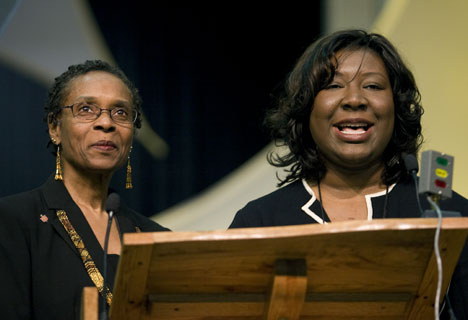
The United Methodist journey toward inclusivity has been like a woodworker creating art out of unrefined materials, the United Methodist Commission on Religion and Race said in a video which celebrated the commission's 40th anniversary.
"Creating a masterpiece is like taking a risk-filled journey. ... It unfolds at stages, requiring patience, persistence and perseverance," said the narrator in the video shown to General Conference 2008 on April 29.
The conference celebrated the birthday of the commission and reflected on the denomination's journey of inclusivity.
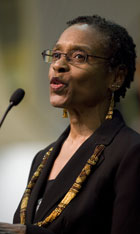
Bishop Linda Lee
"Like all journeys, it hasn't always been easy," Bishop Linda Lee, president of the commission's board of directors, said to the conference. "The church has struggled with racism — both individual and institutional. The experience of racism has caused members of the United Methodist family to march and to preach and to speak out, infused with the energy of righting long-ignored wrongs."
The denomination created the Commission on Religion and Race in 1968 to ensure that racially segregated conferences would fully integrate by 1972, following the dissolution of the Central Jurisdiction, which was drawn by racial, rather than geographic, lines.
The 1972 General Conference voted to make the commission permanent to allow it not only to usher the denomination through integration but also to lead the transition into a racially just and fully inclusive church.
"You know, we were dragging our feet on race . . . I said, you know, we talk about it-we're all God's children, but we ain't acting like it," said Rhett Jackson of South Carolina, an original commission member who presented the proposal to merge the South Carolina conference.
Turned away from churches
The video featured retired Bishop Woodie White, who served as the first executive for the commission until 1984, when he became a bishop. White recalled life in the denomination before the commission.
"In the '60s there were people who were actually turned away from churches because of the color of their skin.... It's hard to believe that that was the kind of church in which we lived," White said.
Soon after the creation of the commission, he said, they realized that their work would go beyond issues of blacks and whites; the commission would also need to work toward multiculturalism because the denomination included Hispanic, Native-American and Asian-American members as well.
The General Commission on Religion and Race has reviewed, monitored and promoted racial inclusivity and reconciliation for The United Methodist Church in its first 40 years. Additionally, it has hosted workshops and training events and published resources to educate the denomination.
"Forty years ago, the inclusion into the Methodist Church demanded by African Americans — was, for many, a radical challenge," said Erin Hawkins, top executive of the Commission on Religion and Race. "Today, in this body of Christ called United Methodists, it is a radical expectation."
New issues to confront
The commission looks to the future, hoping to expand its work "confronting oppression that reaches past United States borders," said Hawkins.
"We have to learn how to confront the new issues from the perspective of inclusiveness," said the Rev. Yolanda Pupo-Ortiz, a former executive of the commission.
"The commission has guided us on our journey to inclusiveness with a bold faithfulness, and it is my prayer that their witness will continue to lead us toward God's kin-dom," said the Rev. Renae Extrum-Fernandez of the California-Nevada Annual (regional) Conference, a former director of the commission.
Following the presentation, commissioners hosted a birthday party in the lobby of the Fort Worth Convention Center, distributing sun catchers and birthday cupcakes to General Conference delegates and visitors.
*Rouse is a freelance writer in Nashville, Tenn.
News media contact: Kathy Noble or Tim Tanton, e-mail: [email protected].
Phone calls can be made to the General Conference Newsroom in Fort Worth, Texas, at (817) 698-4405 until May 3. Afterward, call United Methodist News Service in Nashville, Tenn., at (615) 742-5470.
Related Video
Related Articles
General Conference headlines
Resources
Like what you're reading? Support the ministry of UM News! Your support ensures the latest denominational news, dynamic stories and informative articles will continue to connect our global community. Make a tax-deductible donation at ResourceUMC.org/GiveUMCom.


