

People in remote villages in Nigeria rarely have access to dental care and many suffer with cavities and other oral infections.
To help alleviate some of that suffering, The United Methodist Church in Nigeria, in partnership with the North Alabama Conference, is training community health workers to perform urgent-care dentistry.
A workshop was held at the headquarters of the Central Nigeria Conference in the Karim Lamido local government area July 15-18. It included health workers from the Central Nigeria and Northeast Nigeria conferences.
Clinic includes free
eye exams, treatment
By Ramson Danjuma
During the health clinic, hundreds of patients also received free eye treatment.
“Almost two-thirds of our people in our community have eye problems. … Most of (those) who were treated went home joyfully and giving thanks to our partners and the leadership of (The United Methodist Church) rural health program,” said the Rev. Ahijo S. Tanko, director of connectional ministries for the Central Nigeria Conference.
Among those benefiting was Briston Usman, a 33-year-old student at Taraba State University, who was born with an eye defect and can only see things very close up.
“I am so glad and happy being among the eye patients that have got glasses from this health team. This is a miracle to me. May the Lord bless them.”
Deacon Na’Allah Japheth also received a pair of glasses.
“I am full of praise for having benefitted from this opportunity. We are lucky that the partners chose to come to our conference in particular to give us free eye treatment. … I am praying that they will live long lives to treat other people in some part of the world.”
Danjuma is a communicator for the Northeast Nigeria Conference.
The church collaborated with Nigerian dentist Dr. Albert Akhidenor, founder and CEO of the Community Oral Health Initiative, a nonprofit that aims to improve oral health in communities that don’t have access to dental care.
The program centered on training health workers on the standard practices of instrument sterilization and tooth extraction.
The two-day workshop was followed by a health clinic where the newly trained health workers treated people of all faiths who traveled from their villages for dental checkups.
Akhidenor said the participants are not trained to be dentists but rather to treat minor oral health issues in their communities. Cases that are more serious are referred to a dentist.
“The scope of the training we give to these health workers includes being able to make early diagnosis of oral disease, such as gingivitis (gum disease) and dental caries (tooth cavities), and also to build their capacity to provide oral health education for members of their communities through the ante-natal clinics and school visits, thereby promoting oral health,” he said.
Akhidenor said the workers are trained to carry out only urgent oral treatment.
“Severe toothaches are a dental emergency, and the health workers have now been trained to identify diseased teeth and to do proper referrals where necessary.”
The training is expected to continue for the next four years to make it sustainable, Akhidenor said.
Dr. Bruce Cunningham, a board member for the Community Oral Health Initiative, said this is the second training the community health workers have received and the students now are better prepared to help their communities.
“(After the first training), we didn't give any of these students the instruments, because they did not gain enough competence to be able to take care of their communities,” he said.
Now, he said, the instrument kits will stay in the community.
“All the students that attended the training will come back to have more training on how to use the instruments,” he said, adding that the participants are examined before they receive the tools and begin using them in the community.
During the health clinic, Akhidenor advised community members to take their oral health seriously by cleaning their teeth with either a toothbrush or a chewing stick in the morning and at night before going to bed.
“Parents should supervise the brushing and cleaning of their children's teeth from when they first appear till age 7,” he said.
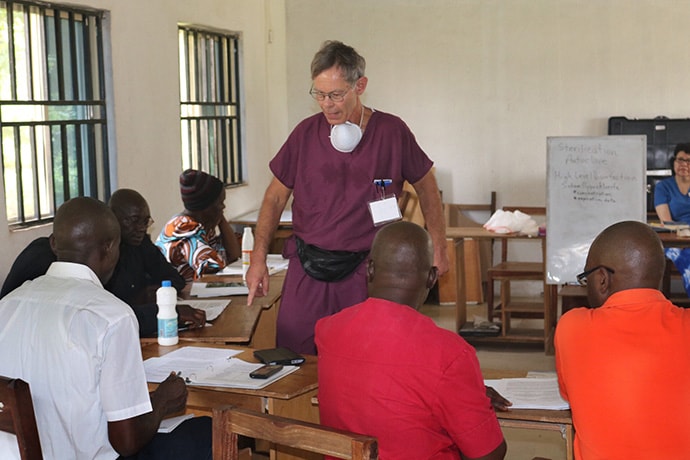
Dr. Bruce Cunningham (center) helps train community health workers to perform urgent-care dentistry during a workshop in Bambur, Nigeria. Cunningham is a board member for the Community Oral Health Initiative. Photo by Richard Fidelis, UM News.
Titus Sabo was the first patient at the recent health clinic to have a tooth extracted.
“I am very grateful to God for sending people like this. I have (had) teeth problems for over one year. I get worried because I don't have money to go to the hospital for the extraction of my teeth, but with the coming of these missionaries, I am now OK. My teeth problem has gone now.
“I believed many have benefited like me. I’m saying thank you. God bless the people that contributed to this program.”
Fidelis is a communicator for the Central Nigeria Conference.
News media contact: Vicki Brown at (615) 742-5470 or [email protected]. To read more United Methodist news, subscribe to the free Daily or Weekly Digests.
Like what you're reading? Support the ministry of UM News! Your support ensures the latest denominational news, dynamic stories and informative articles will continue to connect our global community. Make a tax-deductible donation at ResourceUMC.org/GiveUMCom.


