
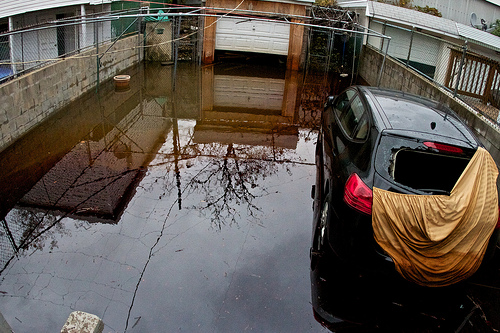
October 31, 2012—The view of just one house in Hoboken, New Jersey, is a microcosm of the incomprehensible magnitude of Sandy’s aftermath.
The home, sitting in floodwaters that overwhelmed a fuel oil tank in the basement, is surrounded by thick, black sludge. Behind the garage, chemicals are seeping out of a flooded factory, forming a thin film on top of the muck.
Cleanup isn’t even on the minds of these homeowners, who have no power and hardly any access to communications. Survival is.
As the Rev. Chris Heckert walked in Hoboken, a fire truck and another emergency vehicle traversed the street, responding to a call from a resident with a downed tree.
“People were following the fire truck, asking the firefighters to come here, come over here, just following the truck, begging to be helped,” said Heckert, pastor at the Morrow Memorial United Methodist Church in Maplewood, New Jersey.
He is doing his part to help, opening the church to the surrounding communities as a place to simply exist. “People are coming in to do work, use the wireless internet, get coffee and let their kids play,” he said.
Churches in hard-hit areas have become an oasis for people who, since Sandy hit, have been cut off from civilization. “No one has scratched the surface of what’s going on in New Jersey,” said Heckert.
People in New York City are in similar isolation, reported Peter Gudaitis, president of the New York City-based National Disaster Interfaiths Network.
“There is water damage all over Manhattan, in the Lower Eastside immigrant neighborhoods, including Chinatown,” he said. “Nobody can access those. Power is still out. Nobody can report problems, so the assessment process is complicated.”
With no electricity, internet, or mass transit, people who don’t have cars can’t get to work, the store, or even to their churches.
“There is a perception that coastal areas are where rich people live. That’s not the case in New York City,” added Gudaitis. “Every day of missed work hurts people from working class families, who rely on a weekly paycheck. They’re not on a salary–they’re hourly.”
Stores are reopening very slowly, he added. Most can’t accept credit cards and, with no power, getting cash from ATMs is difficult as well.
Even as communities in New Jersey and New York City were in the grips of daily survival, they were worrying about the long haul.
“I hope we see some enormous national generosity for long-term recovery,” said Gudaitis.
UMCOR will be there for the long haul. Please help. Donate to UMCOR US Disaster Response, Hurricanes 2012, Advance #3021787 ,. You can also text the word RESPONSE to 80888 to give an immediate $10 donation.
*Susan Kim is a journalist and regular contributor to www.umcor.org.
Like what you're reading? Support the ministry of UM News! Your support ensures the latest denominational news, dynamic stories and informative articles will continue to connect our global community. Make a tax-deductible donation at ResourceUMC.org/GiveUMCom.


