
The United Methodist Communities of Shalom initiative returned to General Conference, where it was born in 1992 as a ministry of community reconciliation and development.
Shalom leaders came not asking for funds but to demonstrate the achievement of the community-development program that provides training in how congregations and communities can work together in seeking health, wholeness and well-being.
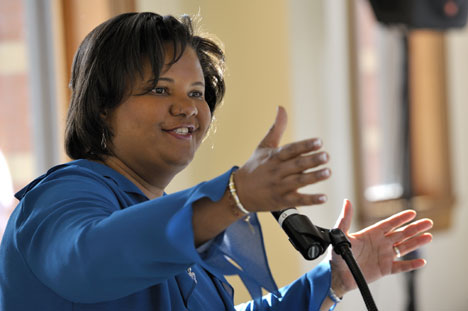
Maxine Clarke Beach, dean of the Theological School of Drew University, speaks at the reception.
A celebration of the Shalom anniversary took place on the evening of April 25 at a hall near the Fort Worth Convention Center, where the General Conference was in session.
The initiative has a new organizational look. Shalom is now a partnership ministry between the United Methodist Board of Global Ministries and United Methodist-related Drew University Theological School, Madison, N.J.
Drew will house the Communities of Shalom Resource Center, providing the initiative and local communities with ongoing training, technical assistance and opportunities for networking.
"This is one of the most exciting partnerships in the church right now," said Washington Area Bishop John R. Schol, chair of the National Shalom Committee and one of the first people to work with Communities of Shalom when it began.
Healing communities
Delegates to the 1992 General Conference gave birth to the Communities of Shalom against the backdrop of civil unrest in Los Angeles following the police beating of Rodney King.
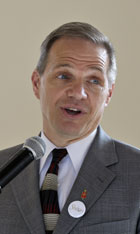
"Out of deep tragedy and deep pain, something very lasting began," says Bishop John R. Schol.
Bishop Joseph Sprague was an Ohio pastor at the time. He asked the 1992 legislative assembly to act as a committee of the whole to address justice issues and the causes of violence. The importance of the biblical concept of "shalom" and critical community-development work led to the creation of Shalom Zones, designed to heal broken communities.
General Conference's mandate said that "in solidarity and consultation with the indigenous persons and local churches in a selected neighborhood, The United Methodist Church commits itself to the creation in Los Angeles of a Shalom Zone with the hope that the Shalom Zone concept becomes a prototype for proactive ministry in other places."
"Out of deep tragedy and deep pain, something very lasting began," Schol said. "We are indebted and grateful to the people of Los Angeles because of what has happened."
Schol said the goal of the initiative and the individual communities has always been to become self-sustaining. The partnership between Drew University and Communities of Shalom combines opportunities for research, training and fundraising and a fundamental commitment to community development, he said.
Maxine Clarke Beach, Drew University vice president and dean of the Theological School, said the school looks forward to the connections and learning opportunities the new partnership will create. Beach said the partnership with Communities of Shalom uses "the best of what we have and know at Drew. Knowing deep in our DNA that we want justice; knowing what we know and equipping our leaders to work in communities."
'More than on the loose'
Bishop Felton E. May, interim top executive of the Board of Global Ministries and the organizing bishop in the early 1990s, recalled the pioneers in Communities of Shalom at the Fort Worth observance.
The dream, May said, was that "peace, health and wholeness could be the foundation of every community across this nation." He emphasized Shalom's specific attention to organizing neighbors in a community and drawing on their strengths.
Schol said 5,000 people have been trained with the Communities of Shalom model in the United States and around the world. "Shalom happens because of people in the community. Shalom happens because of the trainers who work with community members. Shalom is more than on the loose. It's something that lives deep within the bones of The United Methodist Church."
"I can see the impact the training is having in communities and people's lives," says Will Dent.
Will Dent, a senior program associate on the National Shalom Team and one of the original trainers of the Communities of Shalom model for community development, will be training new sites in the church's Western North Carolina Conference, specifically in High Point, Winston-Salem and Greensboro.
"I can see the impact the training is having in communities and people's lives," Dent said. "The Shalom model is one of the best because it is about the empowerment of people."
Sally Vonner, North Texas Conference Shalom coordinator, came to the celebration with several representatives from Shalom sites in the conference. She talked about the passion she has for Communities of Shalom and recalled meeting Schol as the initiative and trainings began. Now there are eight active sites in her conference, many in small congregations that work with children and youth in the communities.
"The impact they have in their community is so powerful," Vonner said. "They can bear witness to how God can take something little and make it very big. Indeed, Shalom is on the loose and will be on the loose."
More information on Communities of Shalom (Advance Number 7425666) is available at www.communitiesofshalom.org or by writing to [email protected].
*Wheeler is editor of Response magazine, the official magazine of United Methodist Women.
News media contact: Linda Bloom, e-mail: [email protected].
Phone calls can be made to the General Conference Newsroom in Fort Worth, Texas, at (817) 698-4405 (817) 698-4405 until May 3. Afterward, call United Methodist News Service in Nashville, Tenn., at (615) 742-5470(615) 742-5470.
Related Articles
National team brings shalom to communities around globe
General Conference headlines
Resources
General Conference 2008
Communities of Shalom
Communities of Shalom
Like what you're reading? Support the ministry of UM News! Your support ensures the latest denominational news, dynamic stories and informative articles will continue to connect our global community. Make a tax-deductible donation at ResourceUMC.org/GiveUMCom.


