
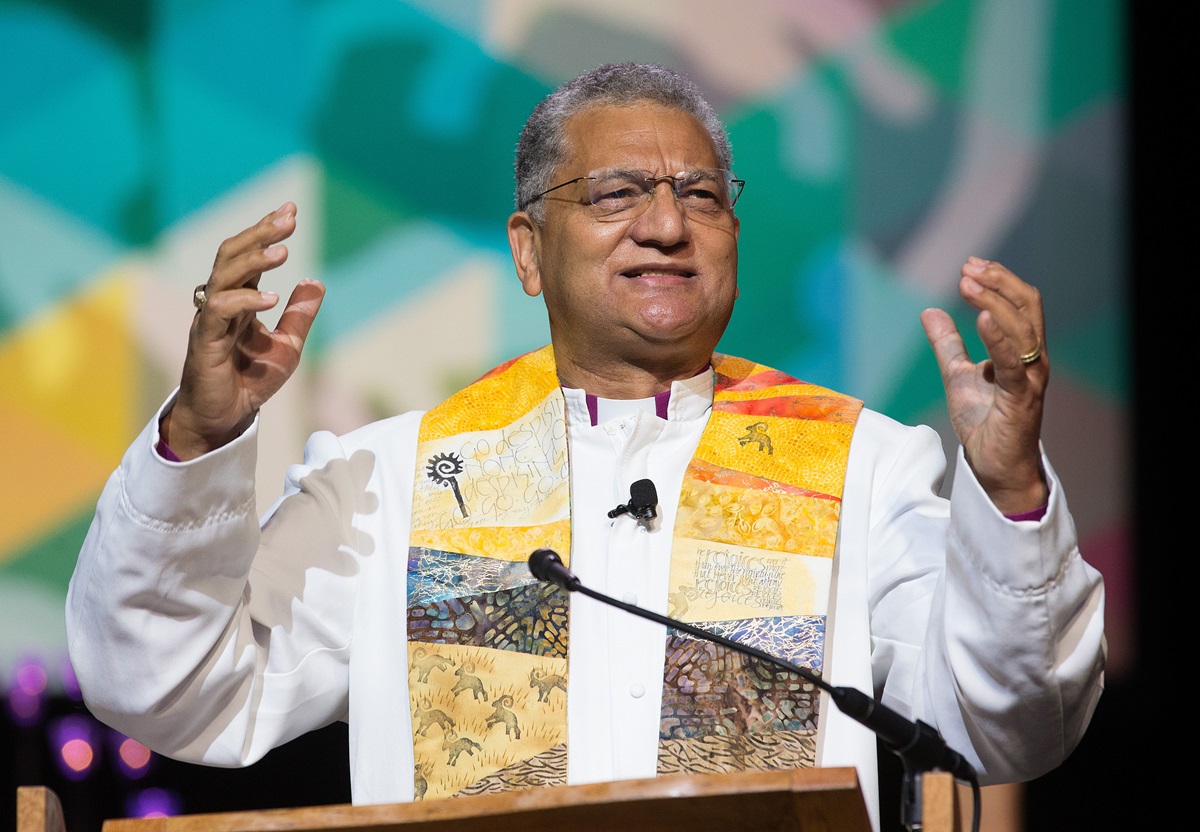
The concept of “empire” has become a reality of the 21st century, says Bishop Ivan M. Abrahams, top executive of the World Methodist Council, and Christians need to be wary of pledging an allegiance to something other than Jesus.
In his May 17 sermon to General Conference 2016 on Matthew 18:10-14, Abrahams, a member of the Methodist Church of Southern Africa, used the sub-theme, “Go in the name of Jesus of Palestine rather than Jesus of Constantine.” He invited the conference to talk about what type of church we want to be: the church of “the least of these” or the church of the status quo.
The people of Palestine always had a quest to be free, he noted. “This yearning for freedom spawned many Messianic movements, and it is against this background that we need to understand that Jesus came to start a new community of sisters and brothers in which there was ‘egalitarian’ relationships, a sign of the kingdom of God.”
Just as Jesus stood against Caesar, the early Christian communities, mostly drawn from lower economic classes “disavowed Roman domination and tyranny,” Abrahams said. “They challenged the lordship of Caesar, and for this reason, they were severely persecuted.”
But in 313 A.D., the Emperor Constantine issued the Edict of Milan, which sought to win the “hearts and minds” of Christians and bring about social cohesion, making Christianity a justification for holy wars. Twelve years later, Constantine institutionalized the faith as a state religion. “Sadly, the church seduced by the politically powerful, endorsed the status quo,” Abrahams said.
Since that time, he declared, history has been littered with examples of the church building its own empires. “To go in the name of Jesus of Constantine is to live comfortably with power, prestige and profit failing to hear the voices of the ‘least of these,’ Abrahams said, placing profit before people and preaching Christ without the cross.
‘The poor don’t have shoes’
“How often do I hear people say that the poor need to pull themselves up by their own bootstrings?” he added. “How cruel is that because people don’t understand reality? Most of the poor don’t have shoes.”
From the time of his birth — in a manger “where anybody and everybody, even the animals, were welcome” — Jesus of Palestine has been accessible to all, the bishop pointed out.
“To go in the name of Jesus of Palestine is not a call for pity or patronage but a call for justice,” he declared. “The poor are not poor by some accident of history, and their lives cannot be mortgaged to transnational companies who serve the idols of neo-liberal economic policies in a casino economy.”
Salvation is tied to our response to the least of these, Abrahams said, and that means witnessing to the Jesus of Palestine outside church sanctuaries. “He is Lord of every sphere of reality, our social, political, cultural and economic life,” he stressed.
“Jesus demands costly discipleship and spirituality that feels the pain of the world,” Abrahams said. “All Christian theology is a public theology shaped on the anvil of justice for those on the margins.”
That is that path which followers of Wesley need to rediscover and reaffirm. “The historian David Hempton argues that Methodism was a religion of the poor, a movement from the underside of history, which sought to transform the world through the empowerment of ordinary people,” he said. “The movement consisted predominantly of women, and singing was a way of doing public theology. Methodism was committed to those on the margins.
“Conference,” he asked, “is this still true for us today?”
Bloom is a United Methodist News Service multimedia reporter based in New York. Follow her at https://twitter.com/umcscribe or contact her at (615)742-5470 or [email protected]
Like what you're reading? Support the ministry of UM News! Your support ensures the latest denominational news, dynamic stories and informative articles will continue to connect our global community. Make a tax-deductible donation at ResourceUMC.org/GiveUMCom.


