
With his country in the midst of political and economic turmoil, Bishop Eben Nhiwatiwa, episcopal leader of the Zimbabwe Area, said that the role of United Methodists in Zimbabwe is to continue to encourage a spirit of peace.
"We need to develop and equip spiritual leaders to promote peace," Nhiwatiwa said. "But we cannot do that alone. We need resources from our brothers and sisters around the world."
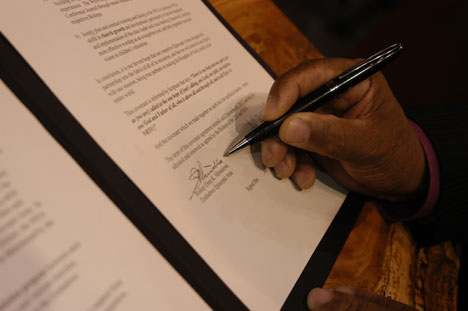
For 11 years, the Baltimore-Washington Annual (regional) Conference has been a resource on which Nhiwatiwa can depend. On April 30, during the 2008 General Conference, the two annual conferences signed a new covenant to extend their relationship through 2012.
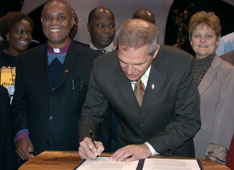
Bishop John R. Schol signs the covenant with the Zimbabwe Area represented by Bishop Eben K. Nhiwatiwa (left).
The covenant states the two conferences will focus on issues such as theological training, community and economic development, young adult ministries, preaching, biblical studies and leadership in the Zimbabwe Episcopal Area.
"This is an important relationship that strengthens both conferences," said Washington, D.C., Area Bishop John R. Schol. "We value our relationship with the Zimbabwe Conference. This covenant illustrates our commitment to helping our brothers and sisters to grow in Christ in a very challenging part of the world."
The two leaders signed the new covenant on a table that was made from trees salvaged from Gulfside Assembly, in Waveland, Miss. a United Methodist retreat center that was heavily damaged by Hurricane Katrina. Delegate members from both conferences were present for the signing.
Schol said the new covenant would extend the work and relationship-building that has occurred since 1997. In 2007, the Baltimore-Washington Conference sent a 13-member team of clergy and laity to Zimbabwe to teach church leadership and community development strategies and skills to about 300 pastors. The team also distributed more than 7,000 insecticide-treated bed nets, as part of the Nothing But Nets anti-malaria campaign.
"This covenant between us and the Baltimore-Washington Conference is a healthy one, because it is something that will really help our churches to grow and support spiritual leaders," Nhiwatiwa said. "I value our relationship with them, and I thank God for their commitment."
*Lane is communications director for the Baltimore-Washington Conference.
News media contact: Tim Tanton or Kathy Noble, e-mail: [email protected].
Phone calls can be made to the General Conference Newsroom in Fort Worth, Texas, at (817) 698-4405 until May 3. Afterward, call United Methodist News Service in Nashville, Tenn., at (615) 742-5470.
Related Articles
General Conference headlines
Resources
Like what you're reading? Support the ministry of UM News! Your support ensures the latest denominational news, dynamic stories and informative articles will continue to connect our global community. Make a tax-deductible donation at ResourceUMC.org/GiveUMCom.


