
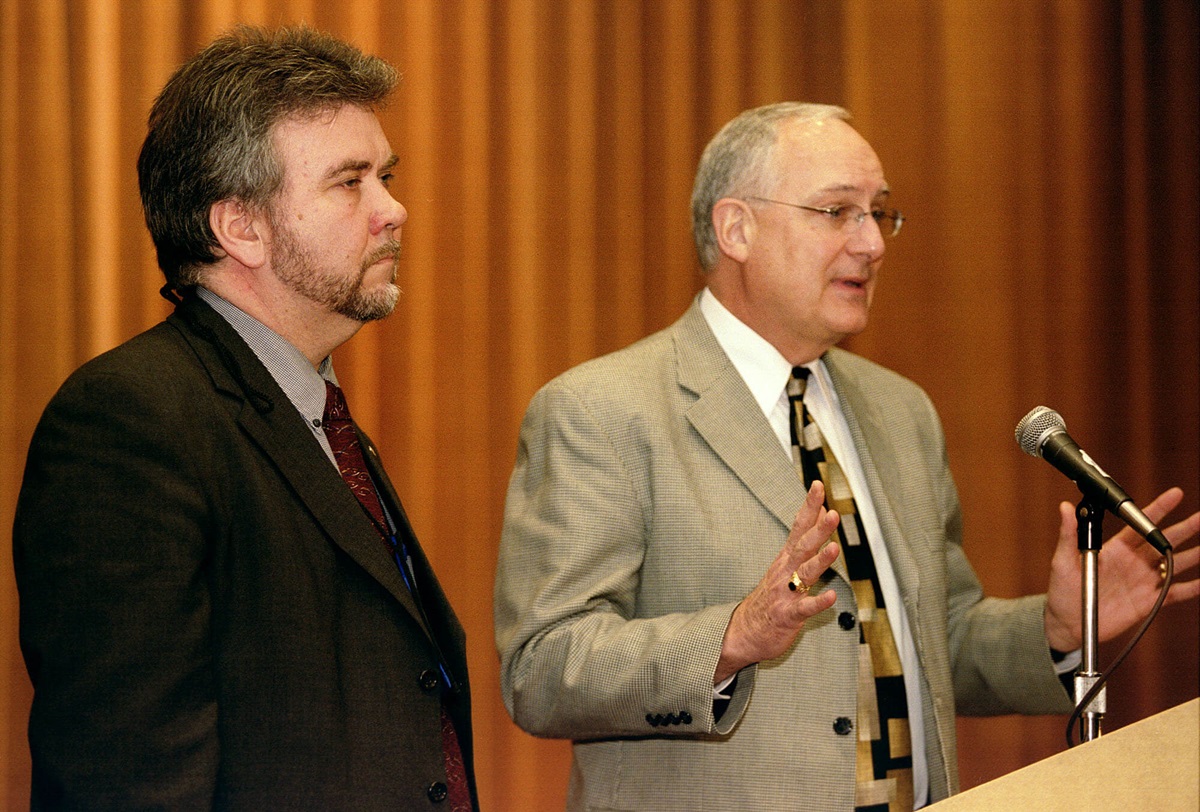
Bringing money and ministry together is an important reason to support the creation of a "Connectional Table" that would guide the work of the United Methodist Church, but it's not the only goal, according to a proponent for the plan.
"The other important thing is to bring the whole church, the worldwide church, together in a new way," said Oyvind Helliesen, a director of the United Methodist General Council on Ministries.
Helliesen and Daniel K. Church, top staff executive of the Council on Ministries, presented the plan, known as "Living Into the Future," to 280 communicators, first-elected delegates and other church leaders Jan. 31 at a Pre-General Conference News Briefing. The briefing, sponsored by United Methodist Communications, focused on the church's legislative assembly, which meets April 27-May 7 in Pittsburgh.
The "Living Into the Future" proposal calls for a common table where leaders from around the church would coordinate the work of most of the denomination's general agencies.
As part of the proposal, the Council on Ministries and the General Council on Finance and Administration would be phased out by December 2006 and their functions merged into the Connectional Table, which would be fully operational Jan. 1, 2007.
The table would consist of:
- One member from each of the 64 U.S. annual conferences.
- Three members from each of the seven central conferences - regional units in Europe, Africa and Asia.
- The president and top staff executive of each general agency.
- Up to 14 bishops.
- Up to 12 at-large members for balance.
"The elected membership of the table would be 50 percent laity, 50 percent clergy, 50 percent female, 50 percent male," Helliesen said. "No less than 30 percent of the members would be persons of racial-ethnic heritage, and no less than 10 percent would be youth and young adults."
Critics of the plan dislike the suggested composition, some on the grounds that annual conferences with higher numbers of United Methodists would not be adequately represented.
After the presentation, Helliesen said the Council on Ministries had struggled with ways to best organize the table. If the General Conference wants to amend the details, "I'm not afraid of that," he said. "I trust the wisdom of the General Conference. The (important) thing is to bring us together as a connection. That's the main thing."
The idea of merging the Council on Ministries with the Council on Finance and Administration is also expected to encounter resistance. Helliesen said that bringing the money and ministry together at a common table would result in a "Spirit-led church" instead of one that is money driven.
The other general agencies would keep their current structure under the Book of Discipline. The president and top executives from two of the agencies, the United Methodist Publishing House and Board of Pension and Health Benefits, would have voice but not vote at the table.
In a video shown at the briefing, two council members - Jay Williams and Darlene Amon - discuss the proposal with Bishop Joseph Yeakel at Barratt's Chapel in Frederica, Del. The chapel was the site of a historic meeting in 1784 between Thomas Coke and Francis Asbury, key figures in early American Methodism.
Yeakel described the proposal in terms of "connecting the connection." A rejection of the plan by General Conference would amount to the church choosing to "retain a disconnected structure," he said.
"We're trying to improve upon the way we do ministries," noted Williams. He added that the plan is not an attack on the general agencies.
"This truly is an opportunity that's before us today, and it's not going to happen overnight," Amon said, noting that the proposal calls for a two-year transition.
Williams recalled how the Council on Ministries placed the proposal on an altar at the end of a meeting in September, offering the plan up "as our gift to the church."
"And now," Amon said, "it's in the church's hands."
Details are available at www.gcom-umc.org online.
News media contact: Tim Tanton · (615) 742-5470 · Nashville, Tenn.
Like what you're reading? Support the ministry of UM News! Your support ensures the latest denominational news, dynamic stories and informative articles will continue to connect our global community. Make a tax-deductible donation at ResourceUMC.org/GiveUMCom.


