
What happens to a community when there is no safe water supply? Look at Flint, Michigan.
The lead that has leached from pipes there remains an ongoing concern. “The problem with Flint right now is this is going to be a generation’s long issue,” says Michigan Area Bishop Deborah Kiesey. “The children of Flint, particularly, are the ones most affected by this poor water.”
From Michigan to Liberia, and Portland to Philippines and Honduras, poor and marginalized communities are struggling with water contamination that threatens everyday life.
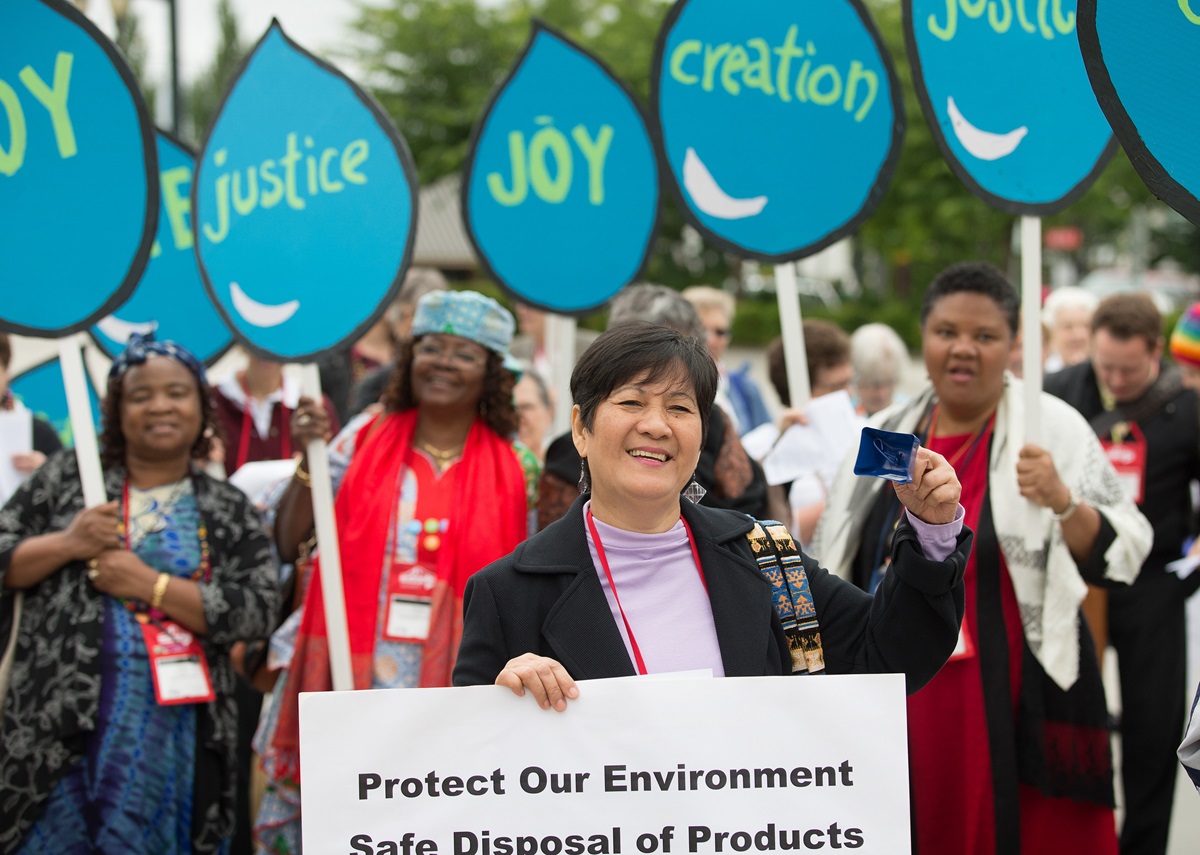
United Methodist Women called attention to their plight during a lunchtime rally on May 16 at the Oregon Convention Center plaza. The event was part of the UMW Day celebration during the United Methodist General Conference.
Michigan United Methodists, in tandem with the United Methodist Committee on Relief, quickly responded to the Flint crisis, but more needs to be done. “UMCOR has agreed to be with us through the end on this, and the end is a long way off,” Kiesey noted.
Michigan’s UMW members also have tackled concerns over the Nestlé Corporation water-bottling plants, said Nichea Ver Veer Guy, a UMW director and head delegate of the West Michigan Conference for General Conference.
The water issue “is disproportionately impacting our poor communities and our communities of color,” she explained, and UMW is working with partners “to defend creation, to defend the quality of life and to defend clean water for all.”
Impact around the globe
Clean water has long been lacking for a poor community in Liberia, recently visited by Rose Farhat, a United Methodist woman from Liberia.
Back in 1926, when Firestone Rubber was asked to stop polluting one of the largest rivers in Liberia, it dumped waste into streams and small rivers used for fishing and for drinking water, Farhat charged.
The result? “You see one generation after the other being impoverished,” she said.
Corporate plantations have siphoned off ancestral lands and resources of indigenous peoples in the Philippines, said Norma Capuyan of an advocacy group in Mindanao.
“We indigenous peoples, since time immemorial, believed that water is life,” she added. “But today, we are a witness to what life is without water. We have been eating farm rats to tide our hunger caused by seven months of drought.”
In Honduras, the Lencas, an indigenous population, have been fighting the construction of a hydroelectric dam for years. But the fact that they were having success in their campaign put their leader, Berta Cáceres, in danger and she was murdered March 3.
Today, the dam continues to be under construction, reported Bishop Elias Galvan, who has supervised the United Methodist mission in Honduras for last 13 years. “As we remember Berta, we remember all who have died in defense of the land and water,” he told the gathering.
Undocumented Honduran women, children and youth seeking refuge in the United States are an example of the “unprecedented amount of forced migration” occurring at the present time, Bishop Julius Trimble of the United Methodist Immigration Task Force pointed out.
“Water rights and immigration rights meet at the intersection of justice and equality,” he declared.
Who benefits from Portland cleanup?
In Portland, the water rights of poor and homeless communities are threatened by an upcoming Superfund cleanup of Portland Harbor and the Willamette River, stressed Cassie Cohen, founder, Portland Harbor Community Coalition, and Ibrahim Mubarak, founder of Right 2 Survive, a houseless advocacy organization.
Advocates are trying to hold polluters accountable, but a sustainably cleaned-up harbor will not benefit all, Cohen said.
Mubarak agreed. “Without intervention, those who have suffered so much in the past will not enjoy the outcomes of a cleaned-up harbor,” he added.
Those attending the rally were given their own calls to action on the local, national and global levels:
- Demand that community voices be heard in plans for the Portland Harbor Superfund Site.
- Call on the White House to issue an executive order to prioritize safe, affordable and adequate water and sanitation for all.
- Support human rights defenders who protector community water and stop militarization of their communities.
Bloom is a United Methodist News Service multimedia reporter based in New York. Follow her at https://twitter.com/umcscribe or contact her at (615)742-5470 or [email protected]
Like what you're reading? Support the ministry of UM News! Your support ensures the latest denominational news, dynamic stories and informative articles will continue to connect our global community. Make a tax-deductible donation at ResourceUMC.org/GiveUMCom.


