
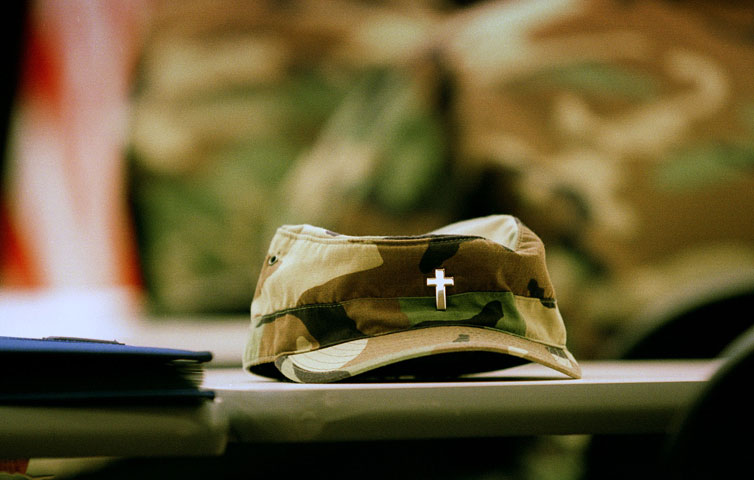
His most recent deployment as a United Methodist military chaplain was officer in charge and chaplain of the mortuary for the theater of operations in the Middle East, located in Kuwait.
In short, his task was to oversee the care of the military war dead.
He also gave his full attention to the spiritual and emotional needs of the staff responsible for the bodies of the heroes who would not be alive to see their families and loved ones.
Surrounded by death on an hourly basis, one of his prayers was for someone anyone back home in his annual conference, or anywhere in his beloved United Methodist Church to recognize and support him in that hard work.
He dutifully sent in his annual report for persons on extension ministry. His chair of the board of ordained ministry, his bishop, his district superintendent and his local church all received that information but no one responded. He fulfilled his mission, did his work, and served as the hands and voice of Christ in a place of death and pain, but his church never said a word.
'Why doesn't my church seem to care?'
This scenario plays out daily in hundreds of locations around the world.
Women and men have answered the call to ordained ministry in The United Methodist Church, and have further answered the call to serve as military chaplains, to care as shepherds for military personnel in sometimes very difficult places. Remember that they are sent by United Methodists to represent you, and to offer Christ in powerful and holy ways.
I recently was privileged to travel and meet with our United Methodist chaplains who are assigned to locations in the Pacific. I was overwhelmed by their dedication and their willingness to serve, as well as by their ability to work in a truly ecumenical setting to care for those who stand in defense of our country. And yet they ask, "Why doesn't my church seem to care?"
Numbers of our chaplains recited similar stories of going home for annual conference, and having people remark that it was probably time for them to come home and do "real" ministry, or of finding either no place to sit, or a place in the back out of the way, no registration packet, no nametag. Their required annual meeting with the bishop often occurred as a lunch in a room with other extension ministers, or those serving beyond the local church, at which there were times when the bishop was "too busy" with annual conference process to even attend.

United Methodist Bishop Woodie White (front row, center) and the Rev. Randy Cross (second row, right) visit with the chaplaincy team stationed at Osan Air Force Base in South Korea. A UMNS web-only photo courtesy of the United Methodist Endorsing Agency.
They spoke of including in their annual reports items about family illnesses, or struggles or even divorces and no response ever came except perhaps to remind the divorcing chaplain to follow the procedures laid out by the annual conference for separation or divorce of clergy.
They spoke with pride about representing The United Methodist Church in the military chaplaincy, and they pleaded for the church to send more pastors to take on the mantle of military chaplain.
Yet, the lament was nearly universal they wished they felt as though their church, in whose name they served, would appear to care at least a small amount about the ministry they were doing, truly extending the ministry of our church and our churches in powerful and excellent ways.
Time for appreciation
Members of The United Methodist Church it's time. For our military chaplains, but also for thousands of United Methodist elders and deacons in extension ministries and ministries beyond the local church, it is time for us to show our care in a consistent, supportive and present manner.
Bishops and superintendents: Find out the names, ministries and settings where members of your conference are appointed and serving, and be in contact with them at least a couple of times per year. Let them know you hold them in prayer, and that you are interested in their lives and ministry. When they come home on leave or for other reasons, find ways to introduce them to your districts, or gather clergy to meet with them.
Annual conferences: Make room, and even find a place of honor for these important partners in our ministry. They feel like fish out of water already, so help them feel more at home, recognize them on the floor of conference and make sure they have access to the journals and other items of news and information from your conference.
Local churches: Adopt a chaplain from your conference, in a similar way to adopting a missionary. Get to know them and their families, and where they are deployed, and pray for them regularly, and most importantly communicate with them through letters, e-mails, cards and any other way you can connect, and keep that "connection" solid and functional.
The clergy who serve in extension ministry and ministry beyond the local church are gifts of God to us and to our church as a whole. Take the time to appreciate their worth and their work, and let's keep the connectional church of United Methodists strong. They deserve it, and need it and so do you.
*Cross is assistant general secretary for supervision and accountability, division of ordained ministry, United Methodist Board of Higher Education and Ministry.
News media contact: Kathy L. Gilbert, Nashville, Tenn., (615) 742-5470 or [email protected].
Related Articles
Military chaplains from Iraq, Afghanistan unite in Elsah and share experiences
A chaplain on call, Wounds of war
Resources
Chaplains and pastoral counselors, Board of Higher Education and Ministry
Like what you're reading? Support the ministry of UM News! Your support ensures the latest denominational news, dynamic stories and informative articles will continue to connect our global community. Make a tax-deductible donation at ResourceUMC.org/GiveUMCom.


