
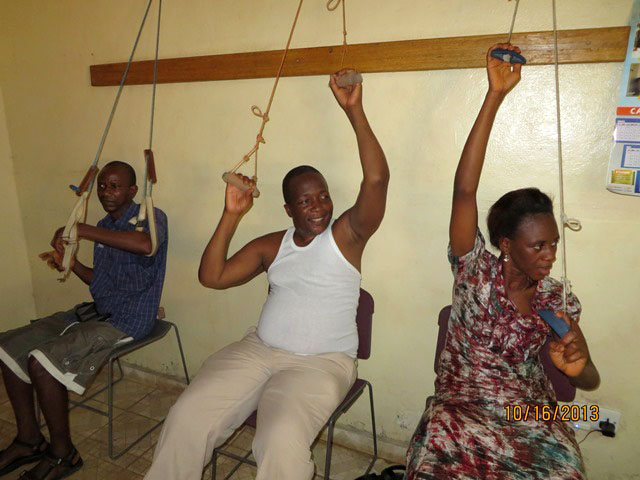
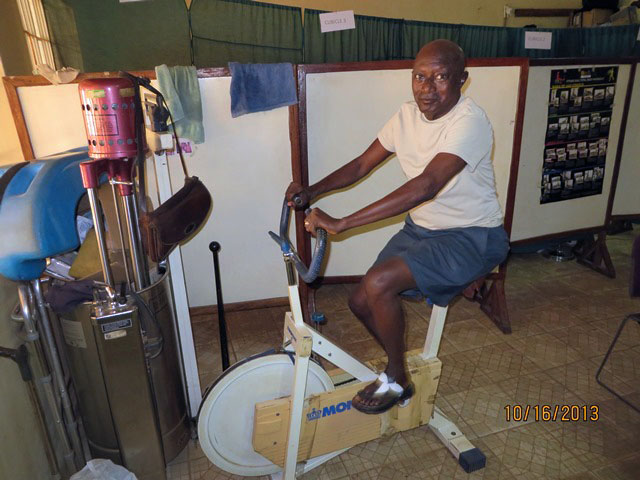
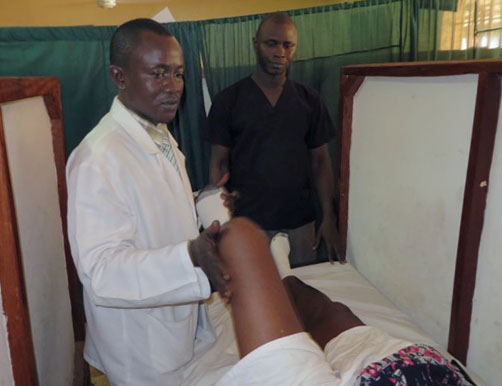
Physical therapy — which started as a volunteer service by a United Methodist — is winning national acclaim for the United Methodist General Hospital at Kissy in eastern Freetown.
Steven Moinina, a physiotherapist by training, has helped many people to regain normalcy and functionality through the now overcrowded Physio-Therapy Unit at the hospital.
Ibrahim Sallieu Kamara, a lecturer at Milton Margai College of Education and Technology, explained how by a stroke of luck he came into contact with The United Methodist Church’s General Hospital’s Physio-Therapy unit, which completely changed his life story.
“I woke up one morning and discovered that I could not stretch out my hands; neither could I walk. I had a feeling that is difficult to name but I felt like a heavy stone was hanging around me and was feeling immobilized. My family became worried and they were looking for help from everywhere. One of the hospitals contacted told my family that I was going to die in five days if family did not seek medical help from abroad. But my family pressed on seeking for a place within the country where I could get help. They took me to Choithram’s Hospital…” ( Choithram’s is one of the leading hospitals in Sierra Leone) . “Again, when the doctor saw me, he thought I would die the next day. I was admitted immediately. I spent about 37 days at Choithram’s and was discharged”.
Kamara explained that even after spending over a month at one of the country’s best health facilities, he could still not walk or move limbs or stand.
“I had to be moved around in a wheelchair. My situation has continued to improve tremendously since I arrived here at Kissy UMC General Hospital. Since then, I have been doing guided physical exercises and in less than a month, I can now walk at a faster pace. Now I can move my limbs and could make effort to stand up on my own.” Kamara said.
The story of Kissy UMC Hospital
The foundations for Kissy United Methodist General Hospital were laid in 1974 by Swedish United Methodists when they sent a nurse/midwife to Freetown on a health mission. Indiana United Methodists from the United States added their ongoing support and United Methodists in Ohio and Baltimore-Washington provided additional help. All of that effort for almost four decades has led to the birth of a hospital from a clinic.
Learn more about Kissy United Methodist Hospital, who it serves and how United Methodists have helped to make that happen:
Kamara said that before the treatment he has received at Kissy, he could not move his left hand to the right hand; nor the right to the left. He explained moving both hands in rapid succession to demonstrate his recovery.
“But now all of that is gone and I feel much more energized and alive”, he said.
He said he preached the previous day for almost an hour.
“People thought I was going to fall down. But I did not,” he said, laughing.
“The guys here are real professionals: treatment is good; they are consistent, caring and treat patients with a human face. They give patients freedom of discussion; they dialogue. These are all aspects that are helping us. They are not like the doctors one would find elsewhere that are dictators or would frown their face. There is fun; there is laughter,” Kamara said of the Physio-Therapy unit.
A United Methodist pastor, the Rev. Steven Momoh Momo-Jah, is recovering rapidly now after he was referred to the UMC General Hospital by a doctor at the Government Connaught Hospital where he was hospitalized first. He suffered a stroke after his blood pressure shot up on July 29. With regular guided exercises three days a week, the now-enlivened pastor says there is a significant improvement in his life.
“I became unconscious and I was unable to talk or walk. People had to carry me on a wheelchair. I can now do everything for myself including taking my own bath, which I could previously not do,” he said.
Momo-Jah said his family was worried that he was going to die because of the recurrent sad events in his life in recent times. He lost his wife and son last year. Momo-Jah said people say all of those trials affected him, which resulted in his illness.
Tigidankay Kamara, 42, a patient with high blood pressure who lives three kilometers away, reports regularly for physical exercises. She suffered a stroke on June 27 in Makeni in the north of the country and could not walk as a result. She can now walk to the hospital to take her exercises. She had been to two other hospitals previously but is realizing more improvement at the UMC General Hospital Physio-Therapy unit.
“Though we are encouraged to take our medication, but the personnel here stress on physical exercises,” she said.
Moinina said the path to establishing the unit was difficult since most people he met, including his colleague nurses, did not believe in it. His first step was to persuade the medical director, Dr. Dennis Marke, to allow him open the Physio-Therapy Unit. After encouraging him to do so, the next challenge was persuading patients to go to the unit for treatment.
“I was working effortlessly; I was going from house to house. I was running after people to make sure I rendered my services,” he explained.
Moinina said his effort was a way of fighting the belief people held at the time about physical disability. He said people attributed physical disability issues to witchcraft and some thought there was no cure.
“My first patient here in this hospital was a stroke victim; an elderly woman whom the relatives had given up. They said there was nothing they could do about her condition, but I told them that I could do something about it. She was not able to walk; she could not stand; her speech was not very clear.
“So day by day, I would come. I would do my bedside physio; I would do massage; I would help her sit in bed; I would help her stand etc ….To an extent; I would devise local exercise tools….”, he said pointing to the series of drill implements he had designed and which patients were effectively using.
“At some point, even some staff members here in the hospital ridiculed my effort and described it as waste of time,” Moinina recalled.
Moinina said the first patient finally recovered about 70 percent of normalcy.
Eventually, some nurses became interested in what he was doing, as well as doctors, and started referring patients to him. At that time, the unit was not yet established. Moinina visited patients in their wards or homes. In 2008, after three years, a Volunteers-in-Mission team from the U.S. state of Indiana arrived and among the team were some physiotherapists like Angie Whittaker, Melissa Clifor and Heather Jones.
When the team returned home, Moinina says, they sent some equipment which is now being used in the unit.
*Jusu is director of communications for The United Methodist Church’s Sierra Leone Annual Conference. News media contact: Tafadzwa Mudambanuke, Nashville, Tenn. (615) 742-5470 or [email protected].
Like what you're reading? Support the ministry of UM News! Your support ensures the latest denominational news, dynamic stories and informative articles will continue to connect our global community. Make a tax-deductible donation at ResourceUMC.org/GiveUMCom.


