
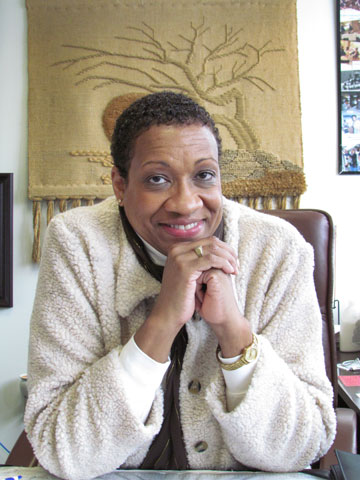
In 1987, Congress designated the month of March that year as "Women's History Month." The annual observance continues to this day. United Methodist News Service invited several women, both lay and clergy, in The United Methodist Church to share their stories. Here is the response from Jocelyn Briddell, new executive director of the Scarritt-Bennett Center in Nashville, Tenn.
3:00 P.M. ET March 21, 2013 | NASHVILLE, Tenn.
Q; Tell us a little about yourself.
A: I was born in Philadelphia in 1959. We moved to Teaneck, N.J., when I was 5. My father, the Rev. David Briddell, is a United Methodist minister, retired from the National Council of Churches in 1993. My mother, La Verne Eagleson, is a musician. My brother, Mark Briddell, died in 1988 from leukemia. My daughter, Syeeda Briddell, 23, teaches junior high school English literature.
Several women have had a tremendous impact upon my life. When I was a preschooler, a woman cared for me every Sunday while my parents were at church. I always looked forward to our afternoons together because she walked me to the corner drugstore for a 5-cent bag of Wise barbecue potato chips and purchased the Sunday paper. When the weather was nice, we sat on her front stoop, and she read me the comic section. She verbally imitated all of the characters as she read the stories from one comic strip to the next. My favorite was L'il Abner.
Years later, when I was sharing this story with my dad, he remarked that she could not read. At first, I was stunned because I believed everyone could read.Then I realized as a 3-year-old, I would not have known the difference. I can only imagine how small her world was without the capability to read. She may have felt powerless since her role in life had been one of a housekeeper and nothing else. However, I also thought about how large her capacity was to know how important it is to read. So, she empowered herself by making sure a little girl's world was full of words and created an imagination and possibly dreams, even though she herself was illiterate. She most certainly was wise and smart, and that is what she gave me.
Q: In what church did you grow up and with what local church are you now affiliated? Are you lay or clergy?
A: I am lay. I grew up in Galilee United Methodist Church in Englewood, N.J. My last church home was New London United Methodist in New London, Conn. I do not presently havea church home here in Nashville since I have only been here two months.
Q: What are your gifts and how do you share them with the church?
A: I must say that I have not given any "gifts" (besides tithing) to the church in a long while. My last church was small with, perhaps, about 20 congregants on any given Sunday.

On International Women's Day, Jocelyn Briddell participates in a march to end violence against women worldwide at Scarritt-Bennett Center, Nashville, Tenn. Photo by Mike DuBose.
Q: How do you nurture others, especially girls and women, through the church and in other aspects of your life?
A: I have had a lifelong commitment to women through higher education. I am a graduate of a women's college and have spent most of my career at women's colleges. Therefore, providing young adult women with the skills necessary to be successful in today's world has been incredibly important to me.
Through my professional work, I created a leadership residential program called the LEAD House for women college students. It was part of the living and learning community at Douglass College, the women's college at Rutgers University. Through a combination of courses, a community-service component and interactions with women grassroots/activist leaders, students learned about women's leadership for social change in a unique residential setting. The first year, I took the group of women to New Orleans since Katrina had just happened that fall. We did community-service work and met with local women who were becoming social activists in their own right because of the devastation in their community. It was very intense dialogue!
Personally, I conducted workshops for young women and girls when I served on the boards for the Girl Scouts in New Jersey, Kente Cultural Center in Connecticut and Connecticut College. I've used different characters like Charlotte, the pig from "Charlotte's Web" and Miss Frizzle from "The Magic School Bus" to talk about communication and self-esteem. These programs provided a space for young girls and women to feel empowered through a variety of skill-building participatory workshops or dialogues. Ultimately, it is critical to provide a foundation where girls and women learn lifelong skills that give them the fortitude, confidence and self-esteem to achieve great work in our communities and in the world.
Q: Why is Women's History Month important to you?
A: Gender equity educator Myra Pollack Sadker said, "Each time a girl opens a book and reads a womanless history, she learns she is worthless." To recognize the achievements of ALL women is so vital to the development of all children but, most importantly, to girls as they grow and mature in this complex world of ours.
Women have served in pivotal roles in our society through science, technology, the arts, education, health, public service, sports and medicine, and our contributions have been the difference between whether someone lives or dies, has lodging or is homeless, and becomes educated or lives a life of ignorance. It is critical that our history is highlighted through Women's "Herstory" Month so we can envision a bright future for ourselves and our dreams are fully realized.
This interview was conducted by Barbara Dunlap-Berg, internal content editor for United Methodist Communications, Nashville, Tenn. Contact Dunlap-Berg at (615) 742-5470 or [email protected].
Like what you're reading? Support the ministry of UM News! Your support ensures the latest denominational news, dynamic stories and informative articles will continue to connect our global community. Make a tax-deductible donation at ResourceUMC.org/GiveUMCom.


