
Court to consider GC2019 request from bishops


The United Methodist Judicial Council has received a petition for a declaratory decision from the Council of Bishops regarding the constitutionality of two General Conference legislative items, Petitions 90052 and 90078.

In giving notice of the bishops’ petition, the denomination’s top court set a 3 p.m. CST Feb. 23 deadline for the submission of opening briefs and a 5 p.m. CST deadline for the submission of reply briefs.

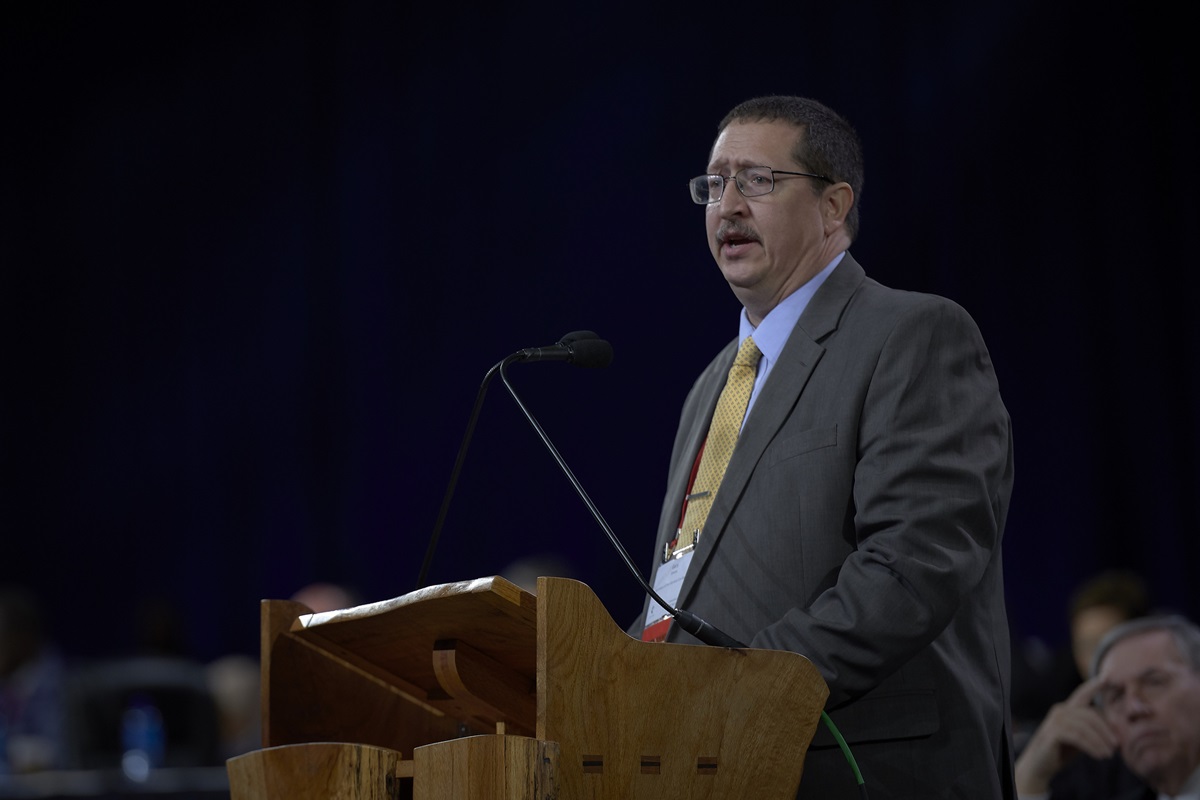
Lonnie D. Brooks Photo by Mike DuBose, UMNS.
Lonnie Brooks submitted petition 90052, which focuses on chargeable offenses found in the United Methodist Book of Discipline. File photo by Mike DuBose, UMNS.
Petition 90052, submitted by Lonnie Brooks, focuses on chargeable offenses found in the United Methodist Book of Discipline in Paragraph 2702.1b — “practices declared by The United Methodist Church to be incompatible with Christian teaching, including but not limited to ...” The petition makes changes related to the supervisory and just resolution processes.

“This petition appears to cross the separate lines of power between the episcopal, administrative and judicial functions and powers similar to other petitions ruled unconstitutional in Judicial Council Decision 1366,” the bishops’ petition said.

In Decision 1366, the court pointed to possible issues with 17 petitions in the Traditional Plan and a few petitions in the One Church Plan. Judicial Council did find the One Church Plan largely constitutional at that time.

Petition 90078, submitted by the Rev. Maxie Dunnam, refers to the Modified Traditional Plan and would create a global episcopacy committee that addresses complaints against bishops related to chargeable offenses. That petition also “appears to violate the separation of powers doctrine,” the bishops said.

Guidelines on how to prepare briefs can be found on the Judicial Council website. Electronic copies of briefs should be emailed to [email protected]

Bloom is the assistant news editor for United Methodist News Service and is based in New York.

Follow her at https://twitter.com/umcscribe or contact her at 615-742-5470 or [email protected]. To read more United Methodist news, subscribe to the free Daily or Weekly Digests.

Like what you're reading? Support the ministry of UM News! Your support ensures the latest denominational news, dynamic stories and informative articles will continue to connect our global community. Make a tax-deductible donation at ResourceUMC.org/GiveUMCom.

Sign up for our newsletter!

Subscribe Now
Human Sexuality
Jan Lawrence addresses Reconciling Ministries Network’s convocation held July 24-27, 2025, at First United Methodist Church in downtown Madison, Wis. Lawrence is retiring after serving as Reconciling Ministries Network’s executive director for nearly a decade. Many United Methodists credit her with helping to lead the denomination to a new day. File photo by Joscie Cutchens, UM News.

LGBTQ leader retires after pivotal changes

Jan Lawrence kept United Methodist advocates organized after the denomination strengthened bans against LGBTQ people and helped lead the way toward the longtime bans’ repeal.
Ecumenism
The United Methodist Council of Bishops and leaders of The United Church of Canada have approved an interim covenant between their denominations. The agreement includes their intent to bring a full communion proposal for the approval of the United Methodist General Conference and the United Church’s General Council, which are both scheduled to meet in 2028. Logos courtesy of United Methodist Communications and with permission of The United Church of Canada.

United Methodists bolster ties in Canada

The United Methodist Church and United Church of Canada have formed an interim covenant with the goal of full communion. Driving the move is increased migration to Canada.
Church History
A 1961 map shows the location of churches and the borders of episcopal areas within the Central Jurisdiction, which the Methodist Church established to segregate Black members from the wider church. The union that formed The United Methodist Church in 1968 dissolved the Central Jurisdiction. During the Council of Bishops spring meeting in Jacksonville, Fla., bishops explored the legacy of the Central Jurisdiction as denominational leaders consider changes to the geographic jurisdictional system. Image courtesy of Archives and History.

Lessons from past shape jurisdictions’ future

United Methodist bishops learned more about the legacy of the segregated Central Jurisdiction and history of the jurisdictional system, as leaders contemplate possible changes to that system.

United Methodist Communications is an agency of The United Methodist Church

©2026 United Methodist Communications. All Rights Reserved