

Key points:
- Ashley Boggan D., top executive of the United Methodist Commission on Archives and History, presented the findings of a report detailing The United Methodist Church’s involvement with U.S. boarding schools for Indigenous children.
- The research includes a list of known schools with Methodist ties and also details how various religious organizations were involved with either funding, staffing or both.
- Remembrance and repentance are the goals of the initial report, Boggan said.
- The Historical Convocation also included historians sharing research about early Methodism in other contexts, day trips to Methodist sites and an awards banquet.
An unprecedented project detailing The United Methodist Church’s involvement with U.S. boarding schools for Indigenous children was at the center of the conversation when the 10th Historical Convocation met Sept. 10-13 in Bozeman, Montana.
The theme of the gathering, “Methodist BIPOC Experiences in the American West,” included leading historians discussing the intersection of Methodism and non-white populations, including Japanese Americans and Native Americans. BIPOC stands for Black, Indigenous and people of color.
In a first-of-its-kind report titled “The United Methodist Church and Indigenous Boarding Schools,” Ashley Boggan D., top executive of the United Methodist Commission on Archives and History, presented findings from a multiyear, multiphase initiative between the United Methodist Board of Global Ministries, United Women in Faith and Archives and History related to boarding schools for Native American children.
The research used data from Archives and History's repository at the United Methodist Archives and History Center, the Department of the Interior and the Native American Boarding School Healing Coalition to compile a list of known schools with Methodist ties. The research also detailed how religious organizations were involved with either funding, staffing or both. The list, Boggan said, is not exhaustive and more research is needed.
“The general philosophy that pervaded the institutionalization of Indigenous boarding schools in North America was one of ‘Kill the Indian to save the man,’” Boggan said. “This genocidal view was one which saw little-to-no positive qualities in the Indigenous way of life, and, instead, viewed the Western form of civilization, including its styles of Christianity, as both inherently superior to Indigenous lifeways and absolutely essential for the salvation of Indigenous peoples.”
Christianity and education were intertwined, creating a movement where missionaries often ran boarding schools, both those on the reservations and off reservations, said Tash Smith, whose presentation was titled “19th Century Methodist Indian Missions and the Boarding School Question.”
This “assimilation mission” also resulted in dozens of schools being financed by annual conferences and mission societies. In this scenario, denominations would get the title to the land and operate the school. The “land redistribution” would take originally Native land and deed it to the church. Later the church often sold the land to make a profit.
Though the practice was widespread, Smith pointed out that, “we should not use context as an excuse.”
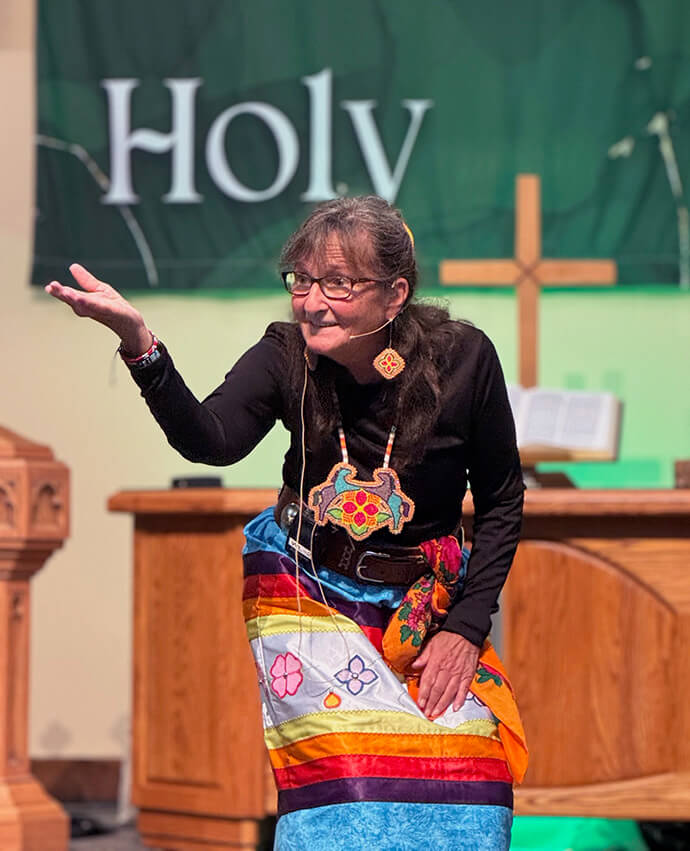
Even as research is conducted and data compiled, the Rev. Chebon Kernell, an ordained elder in the Oklahoma Indian Missionary Conference and director of the denomination’s Native American Comprehensive Plan, reiterates that the “trauma-informed research,” as Kernell named it, explores the experiences of Indigenous people who are still in recovery.
“In the late 19th and 20th century, we were simply trying to survive and I don’t think we are out of that time yet,” said Kernell, who is an enrolled member of the Seminole Nation of Oklahoma and is of Muscogee Creek heritage.
Subscribe to our
e-newsletter
“We’ve justified in our minds not to be aghast,” he said. “We call them ‘re-education centers,’ but there was insidious intent. We were under military occupation. We must un-normalize things such as renaming a child (a common boarding school practice). We have names. Use them so we can recover from this moment.”
The work has just started, all agree.
“In order to hold The United Methodist Church accountable, more stories need to be found and told,” Boggan said.
Kernell said he sees the initiative as an opportunity to make amends.
“Today we have a chance to open doors to the truth and join in efforts so my grandchildren won’t have to suffer like my grandparents,” Kernell said. “Today, we have a chance to say, ‘no more.’
“As a denomination, we must be able to answer these questions: How many boarding schools? What are their names? How many missionaries? What are their names? How many students? What are their names? Are there cemeteries?”
Unsilencing voices
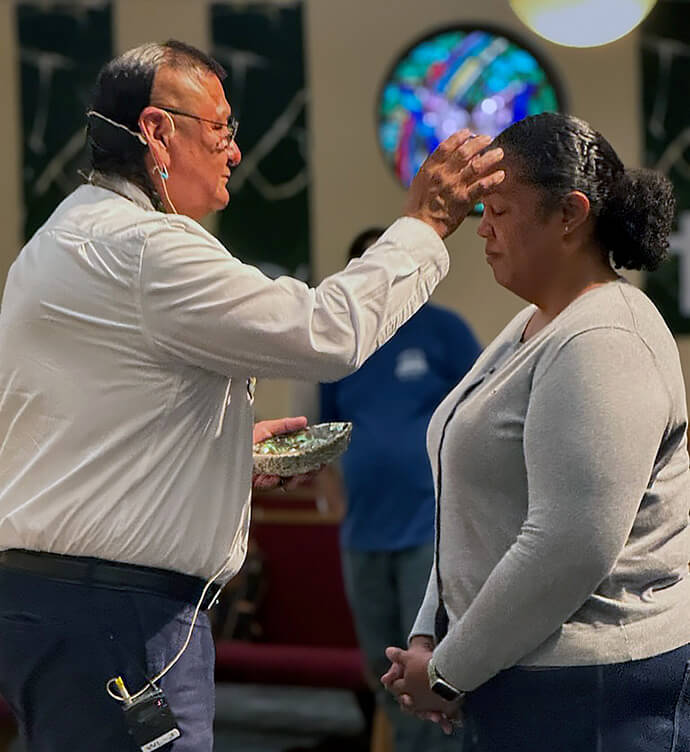
Remembrance and repentance are the goals of the initial report, Boggan said. Now that the information has been made public, the initiative moves into its third phase: The establishment by Archives and History, United Women in Faith and Global Ministries of a dissertation/research fellowship for one to two years of in-depth study into a select number of schools.
“In the meantime,” Boggan said, “these agencies commit to working alongside our Indigenous United Methodists in finding ways to recreate trust, build community and unsilence voices.
“This is about more than merely admitting past wrongs,” she said, “but also the salvation of the soul of the church and uncovering its role in rectifying the innumerable and unimaginable harms of genocide.”
From the Columbia River to the West Coast
In addition to the extensive report on Indigenous boarding schools, a number of historians shared research about early Methodism in other contexts.
Christian Dickerson, assistant professor of history at Quinnipiac University, presented on “The African Methodist Episcopal Church in Indian Territory, 1870-1916.” Benjamin Hartley, professor of Contextual Education, mission and Methodist Studies at Eden Theological Seminary, shared his research on “Early Methodism on the Columbia River, 1838-1844” and Amanda Hendrix-Komoto and Jordan Komoto presented their findings in a report titled “Remembering Minidoka: Methodism and Japanese American Incarceration.”
Beyond Bozeman
The Historical Convocation included day trips to nearby locations, including Butte, Montana, where the group toured sites relative to Methodism. Berkeley Pitt, the world’s largest toxic pit, used to be the site of an Italian Methodist mission church. The group also visited an African Methodist Episcopal Church that closed in the 1960s and the most northern Methodist Episcopal Church South, which closed its doors in 1930.
The quadrennial event was sponsored by Archives and History, the Historical Society of The United Methodist Church, the Western Jurisdiction Commission on Archives and History and the Mountain Sky Commission on Archives and History.
Awards banquet
The Historical Society of The United Methodist Church presented awards during the event. Doug Tzan and the Rev. Ivan Corbin announced that the Local Church History Award was being given to Jesse Andrew Galt for his book celebrating the 200th anniversary of St. John’s United Methodist Church titled “The First Methodist Society in Dover, New Hampshire.” Galt is the historian at St. John’s United Methodist Church.
The Saddlebag Award was given to the Rev. Daniel F. Flores, an ordained elder in The United Methodist Church and senior librarian at Gordon Conwell Theological Seminary for his book, “Respectable Methodism: Nathan Bangs and Respectability in Nineteenth-Century American Methodism (Wesleyan and Methodist Explorations).”
The Ministry of Memory Award is given annually by the Historical Society of The United Methodist Church, with the support of Archives and History, to recognize excellence in archival and historical work. The 2024 honor was awarded posthumously to Richard Stowe. Stowe, who died in July 2023, was the founder and first director of the Local Church Historians’ School, a 12-step curriculum that began in 2015.
Stowe’s work guided hundreds of United Methodists in discovering and documenting their local church histories. The Local Church Historians’ School, which is updated annually, continues to be available online through Archives and History’s education portal at UMHistoryHub.teachable.com. Stowe’s work also was instrumental in Helenor M. Alter Davisson’s grave site at Barkley Township, Indiana, being designated as a Heritage Landmark, which was approved at the 2024 General Conference.
Caviness is the manager of member content development for United Methodist Communications and communicator for Archives and History.
News media contact: Julie Dwyer at 615-742-5470 or [email protected]. To read more United Methodist news, subscribe to the free Daily or Weekly Digests.


